
Promote Understanding
▲ Panel 2 "Future Prospects of Nuclear Nonproliferation and Safeguards Technologies"
-
Dr. Alex BURKART Deputy Director, Office of Nuclear Energy, Safety and Security, Bureau of International Security and Nonproliferation, US Department of States (DOS)
-
Mr. William O'CONNOR Deputy Director, Office of Dismantlement and Transparency, Office of Defense Nuclear Nonproliferation, DOE/NNSA
Mr. Jean CAZALET Deputy Director for Development and Nuclear Innovation at the Direction for Nuclear Energy, French Atomic Energy Commission (CEA)
Dr. Vladimir KAGRAMMANYAN Assistant Director General, State Scientific Center Institute of Physics and Power Engineering (IPPE)
Mr. Yutaka SAGAYAMA Deputy Director General, Advanced Nuclear System Research and Development Directorate, Japan Atomic Energy Agency (JAEA)
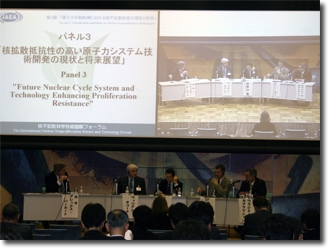
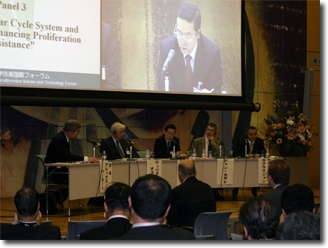
In this panel, panelists from the US, France and Japan made presentations on the current development status, plan, and nuclear proliferation resistance features of future nuclear cycle systems and technologies. These systems and technologies were studied in conjunction with GEN-IV (Generation IV Nuclear Energy System), US GNEP (Global Nuclear Energy Partnership), INPRO (International Project on Innovative Nuclear Reactors and Fuel Cycle) and Japan's Feasibility Study on Commercialized Fast Reactor Cycle Systems (FS). A Russian panelist presented a comprehensive analysis of the scenario for global nuclear energy development.
Presentations were followed by discussions on how to develop these cycles and technologies in the future, including economic efficiency and international cooperation.
(Note: This summary is edited by JAEA Nuclear Nonproliferation Science and Technology Center (NPSTC) on its own responsibility. Content of the summary has not been confirmation by chairperson and panelists)
At the beginning of the panel, the chairperson said that proliferation resistance is most frequently discussed from a technical point of view. However, in reality it is a political concept. A Russian panelist then introduced the outline of discussions on "Proliferation Resistance Fundamentals for Future Nuclear Energy Systems" at the IAEA Technical Meeting held in October, 2002, including definition, intrinsic characteristics and extrinsic measures of proliferation resistance.
- The definition of "proliferation resistance" is not uniform, but the meeting defined it as "that characteristic of a nuclear energy system that impedes the diversion or undeclared production of nuclear material, or misuse of technology, by States in order to acquire nuclear weapons or other nuclear explosive devices". In this definition, national governments are considered as proliferators and subnationals are exempted.
- The degree of proliferation resistance results from a combination of technical design features, operational modalities, institutional arrangements and Safeguards measures.
- Intrinsic proliferation resistance features are those features that result from the technical design of nuclear energy systems, including those that facilitate the implementation of extrinsic measures.
- Extrinsic proliferation resistance measures are those measures that result from States' decisions and undertakings related to nuclear energy systems.
After the introduction, the panelists made their presentations.
Dr. Burkart and Mr. O'Connor: "Global Nuclear Energy Partnership Technology Demonstration Program"
The US GNEP is a new paradigm for the next generation of global nuclear energy and nuclear nonproliferation is a cornerstone of GNEP. Both proliferation risks by States and terrorism by subnationals are considered in GNEP. This new paradigm will incorporate nonproliferation concepts into design, and has created the technology development program. The purposes of this program are to demonstrate the key technologies in the US and to develop various technologies with international partners.
GENP will go forward through international partnership among States with common interests. International cooperation is key to GNEP success.
Mr. Cazalet: "Future nuclear cycle systems and technology enhancing proliferation resistance"
One of essential conditions for the large expansion of nuclear energy is sustainability with the minimization of waste and radio-toxicity, the preservation of natural uranium resources and proliferation resistance. France has selected the "closed fuel cycle, fast neutron reactor" (sodium cooled fast reactor or gas cooled fast reactor) as the best nuclear energy option which fulfills this sustainability.
According to the President Chirac's statement in January 2006, CEA decided to start design work of the 4th generation prototype reactor which will be commissioned in 2020. France naturally welcomes industry or international partners who would like to get involved in this project. The "closed fuel cycle" is already an industrial reality in France.
Currently under GEN-IV, the integrated recycling namely "global actinide recycle", is delineated as a future nuclear cycle system. This is a form of actinide recycling through international cooperation. Spent fuel is reprocessed then re-fabricated in the integrated reprocessing and fabrication plant. New technologies should be implemented for this plant, such as GANEX (Global Actinide Extraction). Re-fabricated fuel is reburned in fast reactors. In this form of recycling, fission products are the only and ultimate wastes from the natural uranium and depleted uranium, since uranium, plutonium and minor actinides are all recycled. Global actinide recycling brings great advantages for nuclear nonproliferation, including reduction of proliferation risk by the minimization of transportation, recycling with non-isolated plutonium, decreasing the enrichment needs and avoiding the build-up of a "plutonium mine".
With respect to nonproliferation, comprehensive strategy and global optimization of the future systems are needed. This means that it is important to incorporate Safeguards concepts into both fuel cycles and reactor technologies, from the early design stages to operations. This is, in other words, the combination of "intrinsic" and "extrinsic" features of nuclear proliferation resistance and this approach is very similar to nuclear safety methodology.
Mr. Sagayama: "Nuclear Proliferation Resistance in Feasibility Study on Commercialized Fast Reactor Cycle Systems"
JAEA and Japanese electric utilities are conducting Feasibility Study on Commercialized Fast Reactor Systems (FS). Phase-II of the FS completed in March 2006 and its result is currently reviewed by the Ministry of Education, Culture, Sports, Science and Technology (MEXT). After phase-II, the FS advances to phase-III then phase-IV in order to present the promising basic design of commercialized fast reactor cycle candidates as well as to confirm their technological feasibility.
In phase-II, R&D and evaluation of several candidate concepts had been conducted based on the FS's five goals, namely safety, economic compatitiveness, reduction of environmental burden, efficent utilization of nuclea fuel resources and enhancement of proliferation resistance. For the evaluation of the proliferation resistance, the following three design requirements were set up under proliferation resistance goal;
- Design for physical protection of nuclear materials and Safeguards
- No isolated plutonium (no plutonium is isolated throughout the whole process)
- Limited access by high exposure from lower decontaminated and/or TRU fuels
Regarding Safeguards technical requirements of (1), the advanced aqueous reprocessing, which was adopted as a promising primary reprocessing process in the FS phase-II, has a strong chance of achieving the goal. In advanced aqueous reprocessing, no plutonium is isolated through entire process. For further proliferation resistance, addition of low grade plutonium into fresh blanket fuel as well as actinide co-recovery is also studied.
Enhancing proliferation resistance is considered an important goal of future nuclear cycle systems in FS. The "extrinsic" features of proliferation resistance would be enhanced by incorporating Safeguards concepts and technologies into the advanced nuclear cycle facilities from their early design stage. In the course of the development, international cooperation is also essential in order to meet changing international circumstances on nuclear nonproliferation.
Russia is now developing a national program of nuclear energy, including fast reactors development, and it will be finalized within a few months.
Currently, nuclear energy systems in fuel cycle countries are based on light water reactors, which is very economical and advantageous. Those cycles, however, have disadvantages including use of uranium, needs for enrichment and plutonium stockpile, which are not always favorable from economic efficiency and nuclear nonproliferation viewpoints. In order to deal with these disadvantages technically, initiatives such as GEN-IV and INPRO have been proposed. However, a technical solution is not enough for nonproliferation problems, especially mid-term problems. In order to deal with this type of problem in an institutional framework, such as multilateral international cooperation Dr. ElBaradei's Multilateral Nuclear Approaches (MNA) and President Putin's initiative of international fuel cycle centers have been proposed. I do believe, however, that none of these initiatives can the disadvantages. The most promising approach today would be a combination of GNEP's institutional approach of a Consortium which would include traditional French reprocessing and Russian fast reactors. In this respect, I understand that the development and construction of fast reactors needs to be accelerated.
Nuclear nonproliferation requirements to nuclear energy differ according to technologies, countries and their global visions. Under these circumstances, every country needs to discuss and collaborate toward global interests by considering these differences.
Presentations were followed by questions and answers among panelists and the Forum audience.Question 1:
-
What are objectives of enhancing proliferation resistance in the advanced fuel cycle technologies? What threats are assumed?
- The objectives vary according to the different states' nuclear programs (nuclear weapon states or non-nuclear weapon states). It also depends on how long the program has been around. They are different in weapon states and non-weapon states.
- Development of advanced Safeguards technology for the whole GNEP fuel cycle is one of one of GNEP's seven elements in its implementation strategy. In this regards, it is the IAEA who decides how Safeguards would be implemented in advanced fuel cycle facilities. Furthermore, it is important to incorporate Safeguards concepts into advanced fuel cycle facilities from their concept design stage.
-
What is the difference between GEN-IV and GNEP?
- The former is long-term program for advanced fuel cycle technologies R&D, while the latter is near-term program for building systems and technologies. For example, the advanced burner reactor (ABR) is a development target under GNEP, while the sodium fast breeder reactor is a target in GEN-IV. Interactions of these two initiatives would create great benefits to the global community.
- The target reactors are different; however, both are technically similar in terms of fast neutron reactor, and both initiatives complement each other.
-
Aren't proliferation resistance and economic efficiency contradictory each other?
- Advanced fuel cycles need to be economically efficient therefore; economic efficiency is one of development goals.
- The best combination of intrinsic and extrinsic features of proliferation resistance may contribute economic efficiency.
- For example, a high burn-up reactor contributes to both economic efficiency and proliferation resistance. In addition, the higher the number of fast reactors constructed, the more the competition would increase.
-
What states could be GNEP partners?
-
According to the United States, partners for separation technologies would be limited to those who already have a full-scale reprocessing plant. However, for other technologies, US will search partners depending on context. As a result, we believe we will reduce the total cost through cooperation.
-
How much proliferation resistance is enough? Is there a limit?
-
This discussion is similar to the discussion on nuclear safety methodology. Certain risks need to be accepted, if we use nuclear energy, since anything involves a certain degree of risk. The level of acceptable risk varies according to the state, circumstances and time.
-
Under the GNEP initiative, transportation of spent fuel from recipient states to supplier states would increase. Doesn't this cause problem from the nuclear nonproliferation viewpoint, as if creating of "plutonium pipeline"?
-
The frequency and operation time of transportation will be limited and they can be fully monitored from the beginning to the end, using both intrinsic features and extrinsic measures.
▼ Closing Remarks