
Promote Understanding
▲ Panel 1 "Future Prospects for Peaceful Use of Nuclear Energy and Nuclear Nonproliferation in the World"
-
Dr. Olli HEINONEN IAEA Deputy Director General
-
Mr. William O'CONNOR Deputy Director, Office of Dismantlement and Transparency, Office of Defense Nuclear Nonproliferation, DOE/NNSA
Mr. Maurizio BOELLA Head of Unit Concepts, Evaluation and Logistics, Directorate I (Nuclear Safeguards), Directorate-General for Energy and Transport, European Commission (EC)
Mr. Kaoru NAITO President, Nuclear Material Control Center
Dr. Gyungsik MIN Manager, Verification Technology Department, National Nuclear Management and Control Agency of Korea (NNCA)
Mr. Masao SENZAKI Director of Nuclear Nonproliferation Science and Technology Center, JAEA
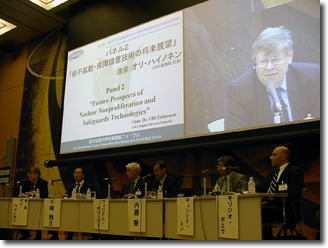
Panel 2 focused on the recent research and development efforts for ensuring effective and efficient Safeguards system as well as challenges and approaches for establishing advanced Safeguards system for the advanced nuclear fuel cycle. Each participant, including a chairperson, made his presentation, and then there was discussion among the panelists and audience.
(Note: This summary is edited by JAEA Nuclear Nonproliferation Science and Technology Center (NPSTC) on its own responsibility. Content of the summary has not been confirmation by chairperson and panelists)
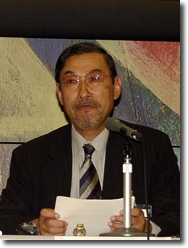 Mr. Kaoru NAITO: "Nonproliferation Policy and Safeguards R&D Initiatives in Japan"
Mr. Naito made his presentation on Japan's nuclear nonproliferation policy, its initiatives for realizing effective and efficient IAEA Safeguards, and the advanced Safeguards technology for the Rokkasho reprocessing plant.
Japan uses nuclear energy solely for peaceful purposes under the Nuclear Nonproliferation Treaty (NPT) based on its three non-nuclear principles and the Atomic Energy Basic Law. The importance of nuclear nonproliferation is emphasized in the "Framework for Nuclear Energy Policy", which was adopted as a Cabinet resolution in October 2005.
In 1999 Japan ratified IAEA Additional Protocol and in 2004 IAEA concluded that "there was neither indication of the diversion of nuclear material placed under Safeguards nor indication of undeclared nuclear material or activities in Japan". Japan is the first case in which integrated Safeguards are implemented to a state with large-scale nuclear activities.
Japan has done its best for the realization of efficient and effective Safeguards including the development and supply of Safeguards equipment and technologies in TASTEX (Tokai Advanced Safeguards Technology Experience), LASCAR (Large Scale Reprocessing Plant Safeguards) and JASPAS (Japan Support Program for Agency Safeguards), and also additional protocol implementation trials and integrated Safeguards rehearsals.
For the Rokkasho Reprocessing Plant (RRP), advanced and large scale Safeguards are required since the plant has large throughput and handles a large quantity of plutonium around-the-clock. Based on LASCAR Projects' findings and consultations with IAEA, advanced Safeguards systems and equipments, including NRTA (Near Real Time Accountancy), solution monitoring, extended C/S (containment and surveillance) and automated data collection and evaluation, have been developed for RRP's effective and efficient Safeguards. An on-site analytical laboratory will be operated for timely chemical analysis of Safeguards samples. The Rokkasho Safeguards Center will also be operated in order to accommodate resident Safeguards inspectors and Safeguards analysts. Similar Safeguards efforts will be taken for Rokkasho MOX fuel fabrication plant (J-MOX) in the future.
Dr. Gyungsik MIN: "Introduction to Korean SSAC and Application of RMS for IAEA Safeguards"
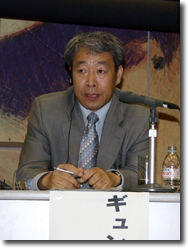
Dr. Min made his presentation on Korean SSAC (State Systems for Accounting and Control) and remote monitoring (RM) systems implemented for Korean light water reactors (LWRs).
In Korea, the TCNC (Technology Center for Nuclear Control) within KAERI (Korea Atomic Energy Research Institute) began Korea's inspection activities in 1977. However, a few R&D projects at KAERI failed to report the use of nuclear material in a timely manner to IAEA. Therefore, the NNCA (National Nuclear Management and Control Agency) was established as a strong and independent national nuclear control regulatory body to inspect nuclear facilities in Korea, such as LWRs, CANDU reactors and KAERI's research laboratories. NNCA's missions include monitoring the non-diversion of nuclear materials, nuclear nonproliferation, export control and improving transparency in the management of nuclear materials. A new organization, which expands the existing NNCA, will be established in July 2006.
With IAEA recommendations, remote monitoring (RM) technology has been applied to the Korean Safeguards system since 1990' as one of the technologies for strengthening IAEA Safeguards system. The introduction of the RM greatly helped IAEA to attain Safeguards goals by combining randomly selected interim inspection activities. Security and cost on RM are improved by the implementation of VPN (Virtual Private Network) and data transfer via Internet.
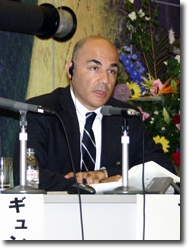 Mr. Maurizio BOELLA: "Status of the implementation of Euratom Treaty Safeguards and related R&D"
Mr. Boella explained EURATOM (European Atomic Energy Community) Safeguards and related R&D activities.
EURATOM organized an expert group to review EURATOM Safeguards flexibility, improvement of effectiveness and efficiency and technology development. In April 2006, a draft document titled "Implementing European Treaty Safeguards" was issued by the expert group. The cooperation Agreement with IAEA is now being defined in accordance with the EURATOM Safeguards role.
Dr. Olli Heinonen: "R&D Priorities for the Department of Safeguards"
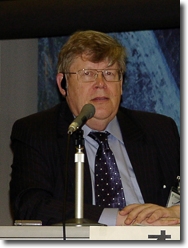
Dr. Heinonen explained IAEA Safeguards technology R&D and Japan's contribution to the IAEA through JASPAS(Japan Support Program for Agency Safeguards).
In "the IAEA Department of Safeguards' Strategic Objectives 2006-2011", which is based on "the IAEA Medium Term Strategy 2006-2011", the following issues are identified as key priorities:
- Development of Safeguards approaches for new Safeguards challenges (ex. integrated Safeguards)
- Optimization of Safeguards equipment and technology
- Enhancement of capabilities in the area of environmental sampling
- Enhancement of the Agency's present satellite imagery acquisition and analysis capabilities
Twenty-two projects were described in the Agency's "Research and Development Programme for Nuclear Verification 2006-2007". In 2005, IAEA Department of Safeguards searched for new technologies in order to track nuclear activities. As a result, 60 proposals were identified and 5 proposals (LIBS, noble gas analysis, Lidar, OSL and Semiconductor sensors for UF6) are being developed further. The Network of Analytical Laboratories for Safeguards (NWAL) is essential to the IAEA efforts on environmental sampling. Regarding this sampling, the focus will be shifted from uranium analysis to plutonium analysis in the future. Information is the heart of modern verification; therefore, new technologies to handle large volumes of information are required in order to improve information analysis capabilities.
IAEA recognizes Japan's contribution to IAEA Safeguards through JASPAS. Japan made a substantial contribution to the establishment of the Safeguards system for Rokkasho reprocessing plant. IAEA is looking forward to Japan's future contributions including Japanese expertise in equipment development, identification of new technologies and increased support for environmental sampling analysis.
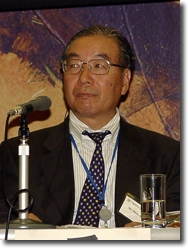 Mr. Masao SENZAKI: "Safeguards R&D at JAEA for the integrated Safeguards, detection of undeclared activities for advanced nuclear fuel cycle"
Mr. Senzaki made a presentation on JAEA efforts for the establishment of effective Safeguards, integrated Safeguards approach and advanced Safeguards system concepts for advanced fuel cycle facilities.
JAEA has been actively engaged in various Safeguards R&D in order to establish an effective and efficient Safeguards approach for its Tokai Reprocessing Plant (TRP), Plutonium Conversion Development Facility (PCDF), enrichment facility, MOX (mixed oxide fuel) fabrication plants and advanced reactors.
Regarding the MOX fabrication plant, design and installation of the "unattended verification system", which was developed with Los Alamos National Laboratory, was incorporated into the plant's design and construction, due to its highly-automated fabrication process. Also for MOX reactors (Joyo, Fugen and Monju), flow monitors and dual C/S R&D has been conducted. Currently, the integration of this data and the introduction of a remote monitoring system are underway.
JAEA keeps an inventory for its many nuclear facilities in a companywide system. The database of the system enables prompt legal action and also responses to inquires on nuclear materials.
The integrated Safeguards approach for nuclear cycle facilities is now being discussed with IAEA, the Japanese Government and the Japan Nuclear Material Control Center. R&D for environmental sample analysis is also now carried out at JAEA's laboratory called "CLEAR", which is certified as one of IAEA network laboratories due to its sophisticated technology.
JAEA is also studying an effective and efficient Safeguards approach for advanced fuel cycle facilities. Such Safeguards need to be implemented from early in the facility design.
Mr. William O'CONNOR: "U.S. Efforts to Advance the Safeguards "State-of-the-Art""
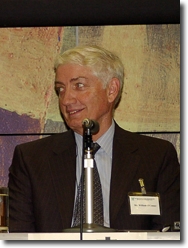
Mr. O'Connor made a presentation on the US challenges and new approaches to state-of-the-art Safeguards.
The US has promoted R&D for Safeguards tools and methods including NDA (Non-Destructive Assay), unattended monitoring and C/S. However, in order to respond to increased need coming from large throughput facilities and advanced fuel cycle facilities (GNEP), new approaches, such as system analysis, modeling and simulation and advanced detector materials and instrumentation, are required.
Advanced measurement of uranium neutron emissions and flow rate of uranyl nitrate is currently developed in order to verify the throughput of a uranium conversion facility. Follow-on applications are expected to be used for monitoring UF6 in feed, product, and tails piping at gas centrifuge enrichment plants.
IAEA's Next Generation Surveillance System (NGSS) project will replace the existing DCM-14 with better image resolution, improved reliability and higher tolerance to radiation environments, improved remote monitoring capacity. Furthermore, advanced sealing systems, including application of the utrasonic technology and improvement of the cobra-seal function, are being developed.
As for advanced fuel cycle facilities, in particular large-scale fuel processing and fabrication facilities, efficient Safeguards approaches need to be implemented and integrated early in the facility design. Furthermore, hold-up NDA measurements must have higher accuracy, while advanced process monitoring must be combined with automated data collection and analysis.
Presentations were followed by questions and answers among panelists and the Forum audience.Question 1:
-
Does an operator need to wait for the IAEA inspector, if the IAEA unattended monitoring equipment fails?
-
The significant quantity of plutonium and uranium is reviewed whenever necessary, and current quantity (8 kg of plutonium and 25 kg of HEU) is admitted as valid by SAGSI (Standing Advisory Group on Safeguards Implementation) of the IAEA ten years ago.
-
Does IAEA consider introduction of plutonium isotopic composition to significant quantity (SQ)?
-
In the case of RRP, inspectors are resident in the plant so they are ready to grasp the situation then take appropriate action. In addition, the recent improvement and progress of the Safeguards equipments enable to avoid such failure.
-
Will the Safeguards be implemented to minor actinide (MA)?
-
MA accounting would not be necessary to consider, since MA is treated with plutonium. The amount of MA could be roughly counted by flow sheet verification. Further discussion would be needed for the implementation of such verification under advanced Safeguards approach.
-
How much Safeguards effort would be reduced by the implementation of integrated Safeguards?
-
The integrated Safeguards concept for JAEA's MOX and reprocessing facilities are under discussion and the new concept has prospects of reducing significantly the Safeguards effort. If so, the concept could be applied to the J-MOX.

▼ Panel 3 "Future Nuclear Cycle System and Technology Enhancing Proliferation Resistance"